

THE CASE FOR THE UNEXPECTED BENTLEY
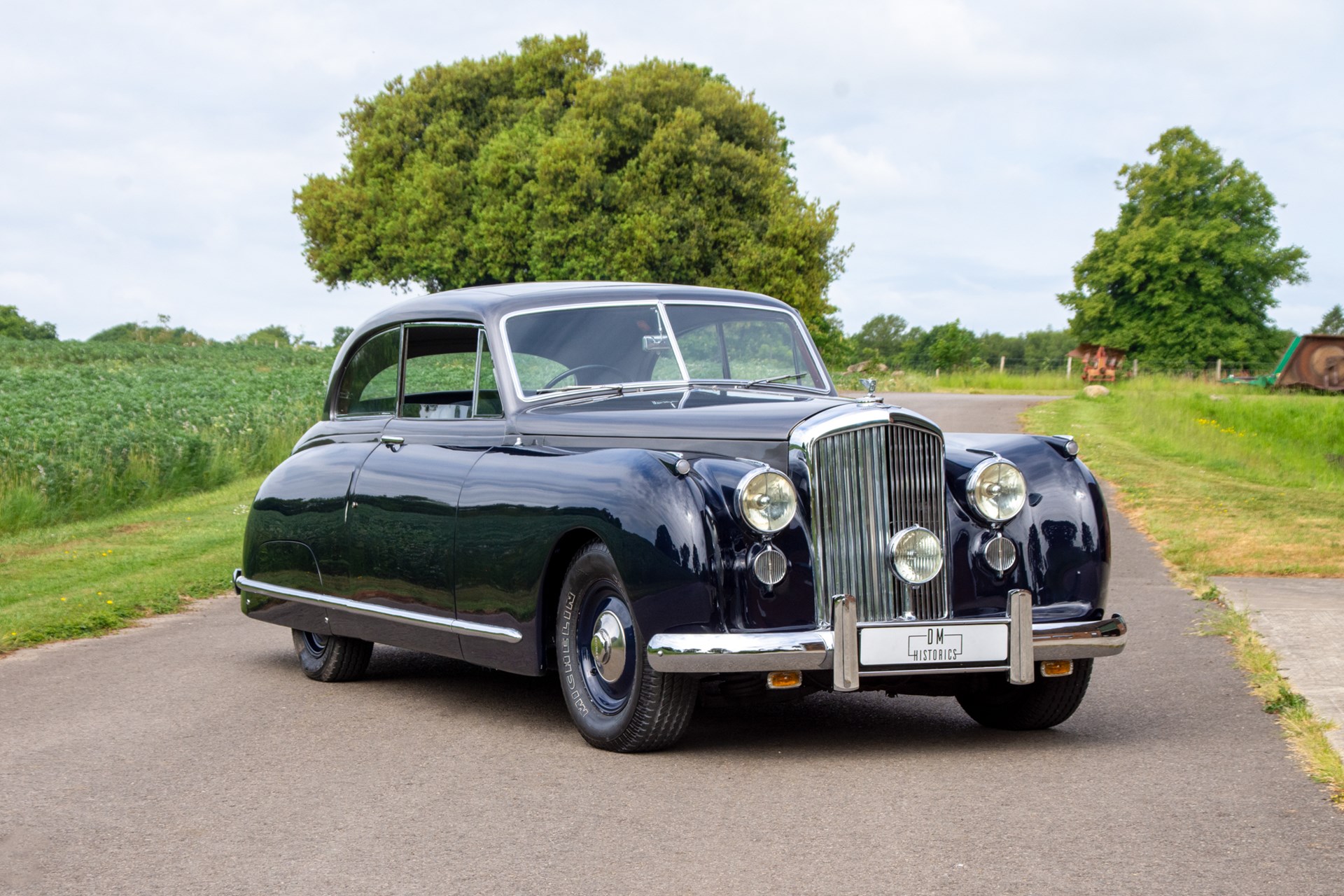
There is a certain type of Bentley most collectors expect: formal, upright, dignified and unmistakably pre-war in character. They carry authority rather than intrigue, tradition rather than surprise.
Then there are Bentleys like this one.
The James Young-bodied Mark VI “New Look” sits firmly outside expectation. It is still unmistakably Bentley in engineering, quality and intent, yet visually and conceptually it represents a pivot point — a moment where post-war optimism reshaped how a luxury car could look and feel.
Owning one is not simply about acquiring a Bentley. It is about choosing the unexpected direction within the marque’s history.
DIFFERENT KIND OF POST-WAR BENTLEY
In the late 1940s, Britain was rebuilding. Materials were scarce, tastes were shifting and manufacturers were rethinking how cars should be designed for a modern world.
Bentley’s Mark VI chassis became the foundation for that change. It was the company’s first true post-war production model offered as a complete car, but it also remained available to independent coachbuilders — firms that created bespoke bodies tailored to individual clients.
James Young of Bromley was among the most respected of these coachbuilders. Their “New Look” design took the Mark VI in a radically different direction: lower, cleaner and far more streamlined than traditional saloons of the period.
Where earlier Bentleys stood tall and formal, this one flows. The bodyline runs uninterrupted from grille to tail. The rear wheels are partially enclosed by spats, smoothing airflow and reducing visual mass. Chrome is used sparingly. The overall effect feels closer to early-1950s continental design than late-1940s Britain.
It is a Bentley that hints at the future rather than reflecting the past.


RARITY WITH INTENT
Coachbuilt Bentleys were never mass-produced, but the “New Look” exists in particularly small numbers. Only a handful were created, and just three two-door saloons were completed in this exact configuration.
That rarity is not accidental. Post-war economics made bespoke coachbuilding expensive, and many buyers instead chose factory steel-bodied cars. As a result, designs like this became rolling statements — highly individual commissions that prioritised style, craftsmanship and personal identity.
Today, that scarcity defines their appeal. They sit in a space between traditional classic Bentley ownership and true automotive collecting: cars chosen not just for heritage, but for their narrative and presence.
ENGINEERING THAT STILL FEELS RESOLUTE
Beneath the coachwork sits the dependable Mark VI chassis, powered by Bentley’s 4¼-litre straight-six.
A straight-six engine — six cylinders arranged in a line — is inherently smooth because the firing order balances vibration naturally. In Bentley form, it delivers quiet torque rather than outright speed, meaning the car builds pace with calm, deliberate effort.
Independent front suspension — where each front wheel moves separately rather than connected by a solid axle — was advanced for its time and contributes to a more composed ride. Hydraulic braking provided consistent stopping power, another step forward from pre-war systems.
The result is a car that feels refined and usable rather than fragile. It behaves as a grand tourer: unhurried, comfortable and mechanically assured.


DESIGN THAT SPEAKS SOFTLY
What makes this Bentley compelling is not flamboyance, but restraint.
The details reward close attention. The curvature of the roofline. The way the rear tapers without heaviness. The minimal brightwork allowing the body shape to carry the design. Inside, craftsmanship takes priority over ornament — figured veneers, carefully engineered switchgear and bespoke touches that reflect the individuality of the original commission.
It is sculpture rather than decoration.
And that subtlety is precisely what makes it stand apart in modern collections, where louder classics often dominate attention.
WHY THE UNEXPECTED MATTERS
Collectors often follow familiar paths: known models, recognised shapes, proven icons. There is logic in that. But the most engaging collections rarely come from predictability. They come from depth — cars that represent turning points, ideas, or overlooked chapters.
This Bentley is one of those chapters.
It marks a moment when British luxury design briefly broke from pre-war tradition and leaned into modernism. It captures the collaboration between engineering and coachbuilding at a time when individuality still defined high-end motoring. And it offers an ownership experience grounded not just in prestige, but in character.
Choosing it is not about buying “a Bentley.”
It is about selecting the Bentley few others considered — and recognising why that makes it special.


AN OPPORTUNITY TO ACQUIRE
Cars of this nature rarely come to market, and when they do, they tend to pass quietly into long-term collections. The combination of genuine post-war coachbuilt rarity, forward-thinking design and strong Bentley mechanical foundations places this example in a very select category.
For collectors seeking something beyond the predictable — a Bentley that reflects both craftsmanship and progressive design — this represents a compelling opportunity.
If you would like to discuss the car in more detail, review the history file, or arrange a private viewing, we invite you to contact us directly. Opportunities to acquire coachbuilt Bentleys of this significance are few, and once secured into the right collection, they are seldom offered again.